Home    Workshops    Members Only    Contests    Join    Contact us                       RWA Chapter
Showing posts with label SFR. Show all posts

Monday, July 29, 2013

Shocking your World to Life by JC Hay

You’ve seen the arguments on-line, so I won’t bother going into the details. Certain entities have accused writers of science fiction romance (SFR) of being light on the science, to the point of leveling the term space opera (as though that were some kind of insult). Despite my pride at being lumped in alongside such luminaries as E.E. “Doc” Smith and George Lucas, I also felt a bit of sting. Could we create better science fiction worlds to contain our heroes and heroines? Could we, in a sense, bring issues out in our fiction, to better illustrate what happens to the human condition when the world changes?

I found a possible answer in an independent but much loved role-playing game from Joshua A.C. Newman – Shock: Social Science Fiction. I realized that a similar method to the one developed by Newman for creating science fiction settings with meaning could be adjusted to world-build better issues and characters into my SFR. Even better, it was generic enough that Fantasy and Paranormal Romance writers could also employ it.
Step 1: Define your “shocks”

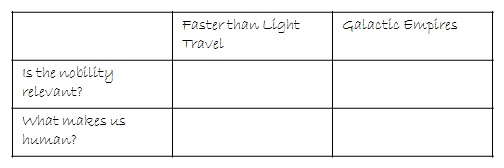
Shocks are the “key concepts” that make your setting different from the modern world; Colonies on Mars, Vampires exist, Faster-than-light travel. You don’t have to think about how these pieces work right now. Indeed, your characters might not have any idea how they work, because the shocks are inherent to the world. Like a car, or the Internet, they are omnipresent. Because of this, they are also your “Free Pass” items. You don’t have to explain them, they just work. While there’s no limit, two or three shocks work well, and more than five stretches the reader’s belief. Write your shocks down across the top of a piece of paper, making each shock a column:


Step 2: Choose your “issues”

Here’s the part where we inject meaning into our setting. Come up with two or three issues you want to address (directly or indirectly) in your story. Issues are the hard questions – the things we can’t easily answer that directly impact your characters’ stories. These can be philosophical issues, such as ‘what makes us human?’ or they can be specific social issues from today (just looking at the news for 60 seconds gives us ‘is the Nobility relevant?’, ‘Are stand-your-ground laws moral?’, and ‘Is it acceptable to reveal government secrets?’)  Note that these are always worded as questions, and while you are likely to have an opinion, they shouldn’t be something that is easy to answer. Write your issues down the side of your piece of paper, creating rows that intersect with the columns:
Step 3: Place your characters

The real key to this method takes place here – pick an intersection between an issue and a shock. Your character exists where these two pieces interact. In the sample, I’ve put our hero, Navigator James Wellington, at the intersection of FTL Travel and What makes us human? This already sets up conflicts for him as a character – navigating at faster-than-light means being modified to be more than human, but is the gift worth what it has cost him? Other characters will view him as different from human, either greater or lesser, and his character arc is shaped by that interaction.

 For another example, in the film “Blade Runner” Rick Deckard exists at the intersection between “Human replicants are nearly indistinguishable from humans” (a shock) and “what defines us as human?” (an issue). The arc of Deckard’s story explore both sides of the argument, contrasted between the two (other) replicant characters Roy Batty and Rachael. Think about how the issue and the shock interact, and about your character’s relationship to both. This gives them an underlying connection to the world, and makes the issues meaningful to the story.


Science Fiction, Fantasy, and Paranormal Romance all deal with worlds that are different from the ones our readers inhabit. By tying our characters firmly into the underpinnings of our stories, we can increase the depth of our characters and make the world we’ve created for them more real to our readers. We increase our ability to add meaning, and give our stories the kind of impact that brings readers back again and again.

 
BIO:   JC Hay writes romantic science fiction and space opera, because the coolest gadgets in the world are meaningless unless you have someone with whom to share them. In addition to Romance Writers of America, he is also a proud member of the SFR Brigade, and FF&P. JC is steadfast in his belief that knitting is relaxing, that kilts are always appropriate, and that Deckard is a Replicant. You can find JC Hay on Twitter (http://twitter.com/j_c_hay), Goodreads (http://www.goodreads.com/author/show/2915850.J_C_Hay), and on his (currently being re-designed) Web site, http://jchay.com.

Thursday, August 28, 2008

Linnea Sinclair featured on The Galaxy Express

This week, The Galaxy Express features FF&P's Linnea Sinclair in celebrating the release of her latest book, Shades of Dark.
For a discussion of Science Fiction Romance, World Building, and Linnea Sinclair's books, catch the author supernova at The Galaxy Express.
Part 1 -- discussion of Science Fiction Romance
Part 2 -- a collection of previous interviews with Linnea Sinclair
Part 3 -- an in depth interview with Linnea Sinclair by The Galaxy Express.

Wednesday, June 11, 2008

What is FF&P?

FF&P Authors on Futuristic, Fantasy, and Paranormal Romance:


Fantasy Romance: All the sweeping, inventive, complex world-building of genre forefathers/mothers such as Tolkein, McCaffrey and Le Guin but driven hard by complicated, delicious, dangerous and often magical love stories that compel heroes and heroines on epic journeys.


Leanna Renee Hieber


Futuristic Romance is Science Fiction Romance's intellectually light-weight little sister. It is STAR WARS with sex. It may be set in the future, which could be high tech, or post-apocalyptic and primitive; or on another parallel world where space travel or inter-dimensional travel is a reality. There can be space ships, hyperspace, robots... but no one wants to know about electro-magnetic propulsion systems, event horizons, and escape velocity.


Rowena Cherry


Paranormal romances are character driven love stories set against the backdrop of an alternate reality where magic, superhuman abilities, and nonhuman species are integral parts of the world in which the hero and heroine exist.


Alexis Morgan


Paranormal Romance is a work of fiction that uses the plot conventions of fantasy or horror and foregrounds a love story between the heroine and hero (or possibly some other character combination in terms of number and gender). The romance provides the structure of the story (e.g., the romantic conflict is solved last, after the external conflict). The central focus on the relationship between the principal characters distinguishes Paranormal Romance from a fantasy or horror novel with a romantic subplot.


Margaret L. Carter


Psychic Romance A story that explores the mysterious and dark territory of the mind, reaching beyond the physical and touching the emotions where they reside.


Eilis Flynn


Science Fiction Romance: Very basically, it's a novel set in a future or alternate and (often) higher-tech setting that fulfills the tenets of science fiction, and where a key conflict in the novel involves the intimate relationship of the main characters. I say basically because science fiction itself is so difficult to pin down (which is why some people use the term speculative fiction).


Linnea Sinclair -- in an interview at Sequential Tart.


Shapeshifter Romance—a story where at least one of the main human characters can shift into another form such as a wolf (werewolf), cat (were-cats), dragons (were-dragons), selkies (seal shifters), etc.


Terry Spear


Urban fantasy is set in a contemporary environment very much like the real world, except that magic and/or mythical creatures exist. It is frequently (but not always) told in the first person from a female point of view, and there is often a romantic plot or subplot. Despite the term "urban" fantasy, it is not necessarily set in a city.


Jenna Black


For more resources, see What is FF&P?