Home    Workshops    Members Only    Contests    Join    Contact us                       RWA Chapter
Showing posts with label editing fiction. Show all posts

Monday, October 21, 2013

"You Are Better Than You Know" by Rory Miller

Author Rory Miller


You’re a good writer.  You are better than you can know.  Let’s crunch some numbers.

You’ve been writing since you were six years old.  Even with no college, that is twelve years of formal training.  Is there any other thing in your life where you have twelve years of formal, expert teaching?  Anything?

And writing isn’t like martial arts, where twelve years of training may be combined with an absolute absence of experience.  You have written for real.  A lot.  Maybe not every day… but I will bet that you read every day.  Maybe you don’t have time to read as many books as you like, but I know you.  You’re a reader.  Cereal boxes.  Labels.  Advertisements. You read. Every. Damn. Day.  And reading and writing are the yin and yang of each other.

Is there any other aspect of your life where you have this combination of skill and experience?  You are good.

But here’s the problem.  You have been writing since you were six years old and almost every single thing you ever wrote was judged.  An outside authority figure who didn’t know and care how your friends belly-laughed would say it wasn’t ‘literary’ or ‘concise’ or ‘choose-your-word’.  And you would get a ‘C’.  Or a ‘B’.  Or an ‘A’ or an ‘F’ but it really didn’t matter.  What mattered is that we were taught, as children, that writing was hard, and judged by secret criteria we could never grasp.  No matter how good we are, all of us were taught we sucked, and it is simply safer not to risk.

If you look at your unfinished manuscript right now, you will hear the voices in your head telling you to give up, that it is not good enough.  Shoot those voices.

Let me tell you a story:

A couple of years ago, a special friend got into some medical bills.  Our circle of friends did what we could, but I suggested we put together a book so that there would be a constant trickle of income.  Problem with making a suggestion like that is that it becomes your baby.  I was named editor.

I call these special friends not because of some weird sexual relationship or because we all rode the short bus together.  This particular circle of friends shared some common history that most people really can’t grasp—former cops and former criminal, operators, EMT’s and patients, we hang out together so that we can tell our stories around the campfire with people who won’t have nightmares (or vomit.)  It’s a tight bond, and an exclusive club.  And a great source for stories.

The first thing I noticed was the insecurity.  Messages would come in that were the e-mail equivalent of, “Mr. Editor, sir,” Head bowed and wringing a hat in his hands, “I have an idea and you probably won’t like it…”

Get this—these were people who had survived mental hospitals, escaped cults and abusive relationships, and hospitalized your worst nightmare.  Bad-asses of the nth degree.  And they were so insecure about their writing that they requested permission to give me a gift with all the subservience of a slave in “Gone With The Wind.”

So I’d say, “Hell, yeah, let me see it.”  And a couple couldn’t even do that.  They sent no manuscript and no more e-mails.

But others did, and every last one was good.  They didn’t use prose like Nelson Algren (who does?  That’s why he’s Nelson Algren and not John Keats or Kristine Kathryn Rusch.)  Some were linear and some were scatter shot.  One was simply a list, a list of things you must do to escape an abuser and that list is possibly the most chilling thing in the book.

So I would send back an email that said something like, “That’s fantastic, thank you!”

And every single one sent back a message saying, “Oh, no.  That wasn’t the real manuscript.  That’s just a rough draft.  Here’s the real manuscript.”

These bad-asses, people who had been a gaijin in a Japanese prison or practiced martial arts in Antarctica or trained counter-terrorism had sent me a draft so that if I rejected it, I wasn’t rejecting them.  “It was just a draft, just a rough outline, really…”  Insecurity.

Here’s the part you need to hear: In every single case (including the case where the author had his retired news-editor wife help with the re-write) the second draft they sent me was weaker.  The first draft they were passionate people communicating about something they loved or feared.  It had passion and clarity.

In the second draft, they were trying to be writers.  Whatever that means.  I suspect that each and every one was trying to make a dimly remembered third grade teacher happy.

Go get four glasses of wine and bring them back to the computer.  Go ahead, you’re writers.  One of the job perks is to be able to sit in your underwear while drinking wine and still generate income.  Got the wine?  Good.  Not hard, right?  I mean, four glasses is tough, but it’s just about moving wine.

Now get four glasses of wine and do it like a circus performer.  Go on.  Come on back and finish this article when something breaks.  It’ll only be a few seconds.

Delivering wine is easy.  Delivering wine like a performance artist is hard.  Writing is easy.  It is just communication, just telling a story—and you are good at it.  Writing like it is some kind of performance art, trying to be a writer instead of just telling a story—that’s not only hard, it has a tendency to ruin the story.

Write.  Just write.  If you really, really care your passion will come through and it will be good.  If you don’t care at all, you will be lazy and efficient and your writing will be clear.  And that’s good too.  But if you try to ‘be a writer’ and either put clarity into your passions or passion into your clarity, or if you try to please your long-dead third grade teacher (and what the hell did she ever write, anyway?) you will ruin it.

You’re good at this.  Put your butt in your chair and fill some pages.  Have fun.

MORE ABOUT THE AUTHOR

Rory Miller is a veteran Corrections Officer who has worked as a mental health specialist; Tactical team member and leader; sergeant and instructor as well as spending over a year as a contractor in Iraq. He is the author of the award-winning "Force Decisions" as well as "Meditations on Violence" 
"Facing Violence" and "Violence: A Writer's Guide." Though he is reluctantly on FaceBook (For now) he does not tweet.  Or text. There is a blog, though, and a website, since he travels all over teaching people about bad guys.
 
BLOG     FACEBOOK     WEBSITE


I hope you will join my class titled
INTRODUCTION TO VIOLENCE
Hosted by
Fantasy-Futuristic & Paranormal Romance Writers
This Four Week class starts November 4th
For more information click HERE

Thursday, August 1, 2013

Ruth A. Casie Talks About....

Editors Collaborators

How anxiously I awaited the edits of my first book, Knight of Runes. Excitement. Well I still had a hard time believing that it would be published. When her letter finally arrived the editing process and timeframes were clearly laid out.
I really don’t know what I expected. I opened the file and felt deflated at the sea of red track changes. I worked diligently on the story. We worked on the plot and made certain it flowed logically (even for a fantasy). We made sure the characters stayed true to their goals and motivations. We tackled flow and story without impacting voice.  I found editing to be a great learning experience and I had a personal teacher by my side all the way. Here are the top ten things I learned from my first round edits. Did I warn you this was a long post? Go get your coffee. I’ll wait.

10.  Well-meaning friends, who are ‘in the know,’ sometimes don’t know. The advice of a good friend and published author was to remove irrelevant words in order to stay in the action and make things sound crisp and immediate. It’s the way to hold your reader attention. Not, however, when you splice commas. Words such as and, but, are essential, not extraneous.
9.    Cut extraneous exposition and let the reader see it. What some people see as extraneous exposition (which I went through and deleted) my editor said was context and necessary to set up the next scene or action.
8.    Don’t give your editor (and reader) a headache by head hopping. Head hopping, I mean real leaps in the same scene, may work for Nora but not for Ruth.
7.    POV is an art. If your POV character can’t see it, hear it, and doesn’t know it then it doesn’t exist. Unless, the other POV character says it or (this was an eye opener) thinks it in his head. Cool heh.
6.    Edits are a learning experience and my editor is a fabulous, and patient, teacher. I learned to see patterns, hear echoes, and feel rhythms. It only took the first 100 pages to get there.
5.    Immediate voice is much more powerful and compelling than passive voice. Chopping ‘ing’ words makes the action sound immediate. It’s essential, although, passive voice has its place, but only occasionally.
4.    Filler words do not move a scene along. These words can usually be eliminated without changing the meaning and will also make the scene more immediate.
3.    Questions in the readers mind can be provocative. Some of my editor’s comments were questions that were answered in the next paragraph or scene. I made my reader think. Not bad!
2.    My deepest apologies to Mrs. X. My high school grammar teacher must be spinning in her grave. I won’t embarrass her by mentioning her name.
The number one thing I learned from my first round of edits…
1.   Call me crazy but I enjoyed working through the track changes and comments. My editor made me think, make decisions, see opportunities, and ultimately helped me make the story the best it can be and isn’t that what we both wanted.
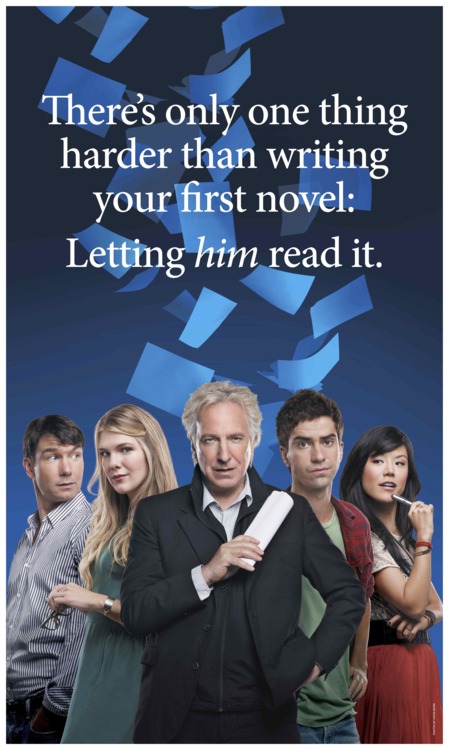
As I waited for the edits for my second book, The Guardian’s Witch which released July 1, my husband took me to see, Seminar, the Theresa Rebeck play staring Alan Rickman, one of my favorite actors. Actually, I visualized him as Bran, the villain in The Guardian’s Witch.

The play is set in present day New York City and follows four young writers and their professor, an international literary figure. Each student has paid the professor $5,000 for a ten-week-long writing seminar. As tensions rise and romance erupts between students, they clash over their writing, their relations, and their futures. At the end of the play, the professor gives each student a gift, a graduation present of sorts, to help them succeed; jobs, pertinent introductions but nothing to do with writing. There is one student who has been the most difficult, who hasn’t truly followed through with the exercises, and challenges the professor at almost every turn. The professor challenges this student to work with him. He will be the student’s editor because he is the one student who has the greatest potential for literary success. The professor goes on to explain the editor – writer relationship.
There is a special relationship between a writer and their editor. The editor knows and understands your story and your characters goals motivations and conflicts as well as you do.
When Alan Rickman spoke his lines I understood exactly what he meant. I had the benefit of my editor working closely with me. Together we were a team that collaborated, brainstormed, and made the story the best it could be. And wasn’t that what we both wanted.  I can’t wait to hand in my next manuscript.

You can find out more about Ruth’s books at:

The Guardian’s Witch – Back Cover Copy
England, 1290

Lord Alex Stelton can't resist a challenge, especially one with a prize like this: protect a castle on the Scottish border for a year, and it's his. Desperate for land of his own, he'll do anything to win the estate—even enter a proxy marriage to Lady Lisbeth Reynolds, the rumored witch who lives there.
Feared and scorned for her second sight, Lisbeth swore she'd never marry, but she is drawn to the handsome, confident Alex. She sees great love with him but fears what he would think of her gift and her visions of a traitor in their midst.

Despite his own vow never to fall in love, Alex can't get the alluring Lisbeth out of his mind and is driven to protect her when attacks begin on the border. But as her visions of danger intensify, Lisbeth knows it is she who must protect him. Realizing they'll secure their future only by facing the threat together, she must choose between keeping her magic a secret and losing the man she loves.
Author Bio

Ruth A. Casie is a seasoned professional with more than 25 years of writing experience, but not necessarily writing romances. No, she’s been writing communication and marketing documents for a large corporation. Not too long ago, encouraged by her friends and family, she gave way to her inner muse, let her creative juices flow, and began writing a series of historical time-travel and historical fantasy romance novels. Her first release, KNIGHT OF RUNES finaled in NJRW’s Golden Heart for Best First Book. Her latest story, THE GUARDIAN’S WITCH, released July 1. Both books were published by Carina Press. When not writing you can find her home in Teaneck, New Jersey, reading, cooking, doing Sudoku and counted cross stitch.  Together with her husband Paul, they enjoy ballroom dancing and going to the theater.  Ruth and Paul have three grown children and two grandchildren.  They all thrive on spending time together.  It’s certainly a lively dinner table and they wouldn’t change it for the world.
Ruth is President of the Board of Trustees of Shelter Our Sister (SOS), Bergen County’s shelter for victims of domestic violence.


Monday, January 14, 2013

Revising with Timelines by Laura Bickle


Writers tend to get into a lot of trouble with time. There's making time to write, managing deadlines, and the vagaries of market timing.

One issue with time, however, is entirely within the author's control. And that's the timeline of the story.

I never paid a whole lot of critical attention to time when I read. Sure, I was conscious that some passages in stories could be languid and slow-moving like a drippy faucet. Others were exhaustingly rushed. I never was quite able to put my finger on why.

And then, when my first book was accepted for publication, I discovered the answer:  books can grow timeline issues. They're very subtle, but can really cause problems with the reader's perception of a work.

A timeline problem occurs when characters have too many events crammed into a period of time - or not enough. A succession of tasks emerges that would require the bending of the rules of the space-time continuum or superhuman abilities to accomplish. It occurs when your main character hasn't slept for days. It happens when she travels an impossible distance in an hour. It can take place when your main character hasn't worked regular hours at her day job without explanation. This goes for crazy amounts of overtime, or not working at all. It happens when your character is doing "cop stuff" for seven days in a row without a day off or at least a pro forma request for overtime.  It's easy for an author to lose track of what day it is, and a character can get trapped in a month-long weekend or a year of Wednesdays.

Mundane concerns? Maybe. But they catch an editor's eye and seep into the subconscious of the reader. And sometimes, we've gotta pay attention to the rules of the real world - like time - in order to allow the reader to suspend disbelief for the really magical things we want to do with the story.

My editor asked me to turn a timeline in with my book. Something simple, listing the day, night, and all the scenes that happened in each. By reviewing my manuscript in this way, I could see where I crammed too many activities into the heroine's day  - or (eep!) not enough. When I finish a draft, I read through it and start constructing my timeline.

I also create a second list that's not strictly a timeline. It's one that notes where chapters begin and end, how many scenes are included in the chapter, and how many pages each chapter is. Sticking a ten-page chapter next to a twenty-five page chapter creates unevenness, and keeping a note helps me be more aware of it. It also shows me where I have a bunch of stubby two-page scenes strung together. This causes me to question whether I'm head-hopping or whether I really need to find a way to collapse those scenes into less choppy ones. It helps me analyze flow. It also shows me whether I'm doing a good job of ending chapters in the middle of the action, causing the reader to want to turn the page to the next.

By doing this kind of post-hoc analysis, and correcting the results, I found that pacing issues automatically ironed themselves out.

I've turned a timeline in for every book since, whether or not I was asked. And it's really reduced the amount of time I spend fixing structural issues in revisions. Now, I tend to work with that timeline in my head, and it keeps me honest. It keeps my very human characters from turning into Wonder Women and Supermen.

Not only do I have to manage time, but my characters do, too. Maintaining a timeline is a front-line editing fix I suggest that every writer keep in her toolbox.

________________
Laura Bickle’s professional background is in criminal justice and library science, and when she’s not patrolling the stacks at the public library she’s dreaming up stories about the monsters under the stairs (she also writes contemporary fantasy novels under the name Alayna Williams). Laura lives in Ohio with her husband and five mostly-reformed feral cats. THE HALLOWED ONES is her first young adult novel. For more info about Laura and her books, please visit her website at www.laurabickle.com. She’s also on Facebook and Twitter, usually exclaiming over cute cat pictures and nerdy things.